Posts

Showing posts with the label Leadership

Education FTW (for the Win-Win)

Image
  I wonder: Can educators serve students, society, and generate wealth for themselves and their organisations through win-win avenues? Exploring social entrepreneurship in education might help us unlock opportunities and solutions. Over the last few years I have been thinking a lot about creating win-win opportunities - where they can exist in education and what they might look like in my life. I wrote a little about it in this blog post. I also have been increasingly curious about the role of social entrepreneurship in education, particularly in schools (as opposed to EdTech companies on the fringes). Inspired by a fascinating win-win story: Maui Nui Venison Today I was inspired by an amazing win-win story in this Tim Ferriss Podcast episode with Jake Muise. Jake Muise runs a meat store that sells ‘responsible red meat’. When I heard this my first thought was just another meat company that minimised the suffering of animals, using humane means for slaughtering. Really nothing ...

Crafting Communications with Care: Because life is too short for ugly presentations

Image
  Crafting Communications with Care: Because life's too short for ugly presentations The Idea: It is valuable to invest time and care in creating visually appealing presentations. Well-designed presentations enhance communication, engage the audience both intellectually and emotionally, and have a lasting impact. To help here are five simple recommendations for creating appealing presentations: (1) Draw out the message clearly before designing (2) Reduce visual clutter (3) Organize information to promote processing (4) Invest in learning to use design & presentation tools available to us (5) Leverage templates provided by professional designers. Educators and communicators will benefit from recognising the value of design skills in conveying ideas powerfully and fostering engagement. “Life is too short for ugly presentations” - Seth Godin  Today, Seth Godin ended his blog post with LIFE IS TOO SHORT FOR UGLY PRESENTATIONS. Immediately I highlighted the statement and...

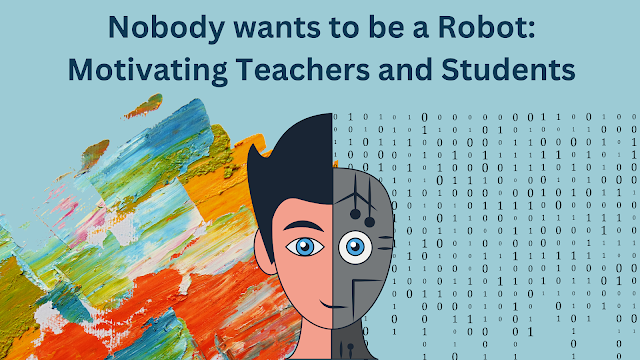
Nobody wants to be a robot: Motivating Teachers and Students

Image
The Idea: Both teachers and students are motivated by the same fundamental attributes: Competence, Relatedness, Purpose, and Autonomy. By establishing professional and learning environments that facilitate the growth of these core attributes, we can cultivate communities of motivated educators and students.

Mission Possible: Balancing Bold Vision with Practical Action

Image
The Idea: Finding the right balance between "impossible" stretch goals and "possible" achievable goals is key to achieving success in complex systems such as education. Both types of goals serve important purposes, with stretch goals providing a bold vision and inspiration, while achievable goals provide practicality and encourage action. By combining the two, you can create a dynamic that inspires innovation while also ensuring that progress is sustainable and tangible!

Large and Small Schools: Leverage your upsides well

Image
The idea: The size of your School/ Organisation can offer unique advantages to your strategy for creating impact.  Smaller schools can leverage quick alignment on Vision and Culture and Organisational Agility. Larger schools can leverage Institutional knowledge, Diverse/ Specialised Teams and Centralised resources for scaling impact.

25 Books that offered me wonderful guidance as a School Leader

Image
Here is a list of books that have influenced my thinking in different areas. They have been a very important source of guidance in my journey as a school leader. So I thought it would be a good idea to compile and share some of them for anyone who might benefit!

Data can deceive. Get to know your data better to avoid this

Image
The Idea: Data-informed decision-making is very valuable, but the users must also ‘know their data’. This means that users should not just jump to drawing conclusions for data they have access to, but also know what specifically the data is measuring, and how the data was collected. Without this crucial aspect of data literacy, the user is susceptible to deception by data. Encouraging questions and conversations during the data analysis process can support the development of this ‘know your data’ aspect of data literacy.

Patient Optimism in Education

Image
The Idea: Patient Optimism is important for anyone striving for Transformation in Education. Change in this complex context is more likely to be incremental, and brought about by the advancement of both - technology and thriving communities, together.

Screen Time: An important perspective for educators & parents from screen time research

Image
The idea: This quote from the paper summarizes the message: 'For parents and educators, we suggest that, “it is time to move beyond a heavy focus on risk with little exploration or recognition of opportunities ”, and instead leverage the strengths and benefits of ST in a purposeful way while mitigating any associated risks during these exceptional times'

Essential EdTech Ideas: from 'Failure to Disrupt' by Justin Reich

Image
  The Idea: Stay optimistic about Edtech but also think Long Term. Sustainable Change is most likely to be incremental, especially in complex educational systems. Edtech along with Learning Communities, has the best chance of bringing about positive sustainable change at scale, in education.

My win-win obsession. If you aren't on already, I hope you jump on this bandwagon too!

Image
The Idea: Consider pursuing Win-Wins or Positive-Sum partnerships, they can be a high leverage path to team success.  Positive sum situations are those in which many people can gain, as opposed to zero-sum games in which if one person wins, someone else must lose.

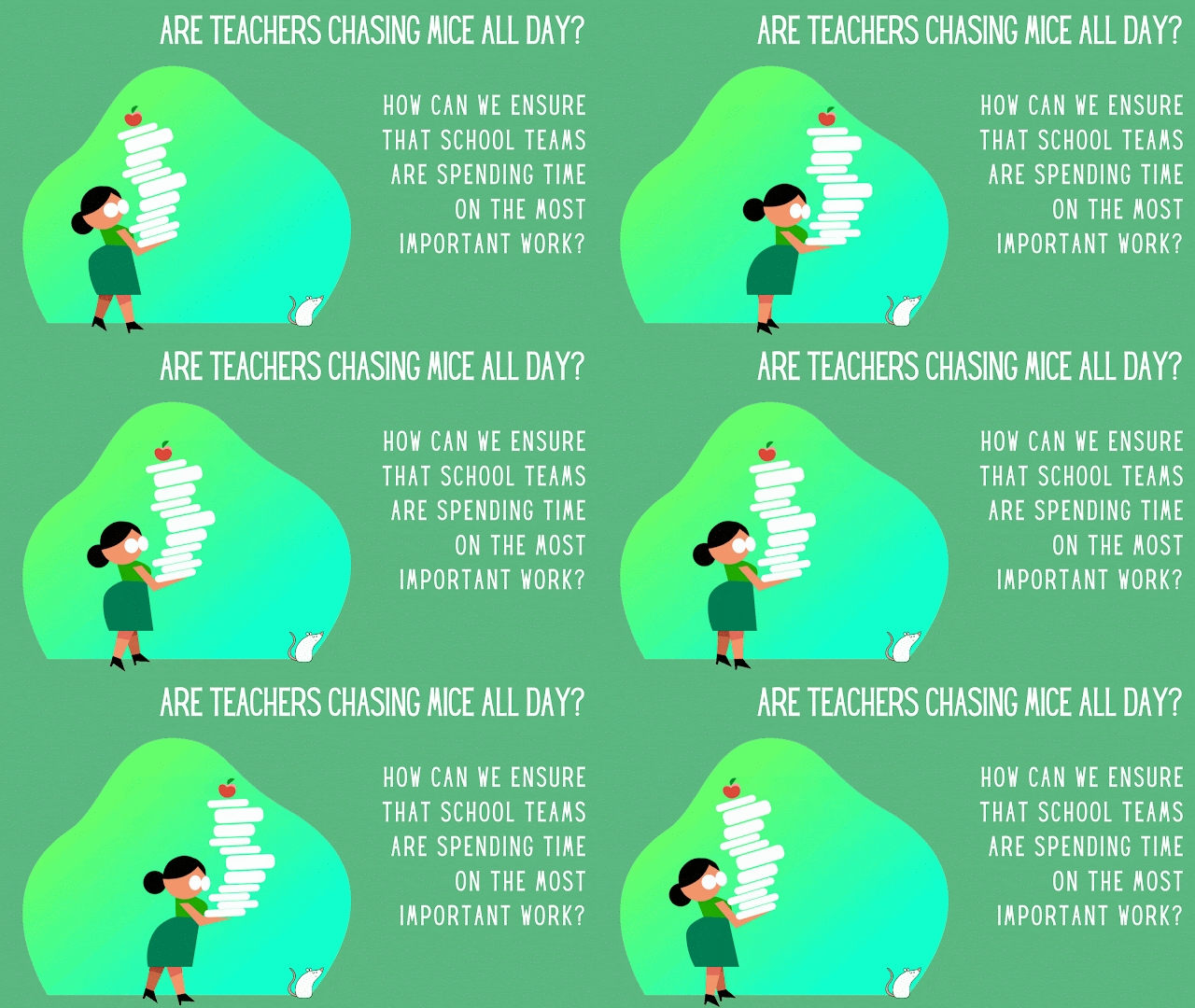
Are Teachers chasing mice all day? How can school teams spend their time on the most important work?

Image
  The idea: Work that impacts student learning is the most important work. We need to to prioritize this work over less important tasks that fall on a teachers' plate. This can be done by (1) Prioritizing - knowing which tasks are most important and making time to do them first; (2) Optimizing - ensuring that productivity and collaboration are happening in the most optimal way possible; (3) Empowering the team to prioritize their work and optimize their time effectively.

Why School Leaders should pay attention to 'Positive Outliers' in their organizations

Image
The Idea: School Leaders need to look out for ‘Positive Outliers’ - the few team members that tend to be unconventional problem solvers in their workplaces, even with the same challenges and resources as their peers. Leaders must recognize the potential of their ideas and knowledge and leverage them for solving the many complex challenges that schools encounter.

What-Why-How: The structure you need to communicate any idea powerfully

Image
The idea: ‘What-Why-How’ - a structure to communicate any idea powerfully. This works well for Teacher Professional development, Classroom Lessons, Team communication on new initiatives or programs.  The What-Why-How structure has been my go-to structure for communicating important ideas to anyone. I have been using it for 5 years now and it has improved the quality of my communication tremendously.  Let me use the What-Why-How structure to describe the What-Why-How structure!

Every teacher striving for inclusive classrooms must know these 6 fundamental ideas about learning

Image
The idea: An individual's learning experience is impacted by several environmental, physiological and socio-emotional factors. As educators, we must be aware of the impact that they can have on learning if we are to achieve 'Neurodiversity as the norm'.  I spent 5 years working at a special education school. That wonderful experience and community has dramatically impacted my outlook on learning and life. This 3 Part blog is me taking stock of the important principles I have learned (1) About Beliefs (2) About Learning (3) About Teaching. Maybe some of them will be useful to others too!  This is Part 2 - On Learning Here is the link to Part 1 - On Beliefs  Here is the link to Part 3 - On Teaching (coming soon) My experiences in Special Education brought to light some very important fundamentals about learning. We had few students but with very diverse learning profiles. I learned so much about things in the environment or brain that can impact learning. It is important fo...

Beliefs about Inclusion and Equity that you should be adopting

Image
  The idea: The massive progress we have made as a society in the 21st century encourages us to re-evaluate our existing paradigms and redefine what we believe is possible. I believe social and technological advances today have readied us to embrace ‘Neurodiversity as the norm’ and thereafter ‘Universal Design’ Approaches. I spent 5 years working at a special education school. That wonderful experience and community has dramatically impacted my outlook on learning and life. This 3 Part blog is me taking stock of the important principles I have learned (1) About Beliefs (2) About Learning (3) About Teaching. Maybe some of them will be useful to others too!  This is Part 1 - On Beliefs Here is the link to Part 2 - On Learning   Here is the link to Part 3 - On Teaching (coming soon)

How do you balance Top-down with Ground-up for an innovative culture?

Image
The idea: Distributed Leadership is a powerful tool for building learning organizations that continuously learn and innovate. But central to distributed leadership is also a balance of top-down and ground-up approaches : Shared vision driven by leaders but influenced by individuals; Autonomy balanced with individual responsibility; Psychologically safe environment for collaboration balanced with honest, open dialogue; Experimentation and risk-taking balanced with individual/ team competence and discipline. In my previous blogs I introduced the synergy of Distributed Leadership  and a Culture for Distributed leadership . In this blog, I will expand on key supporting features and the simple but important balancing forces needed to make Distributed Leadership approaches thrive. While I was discovering the importance of these balancing forces through my work, I came across an article in Harvard Business Review - The hard truth about innovative cultures that put words to my e...

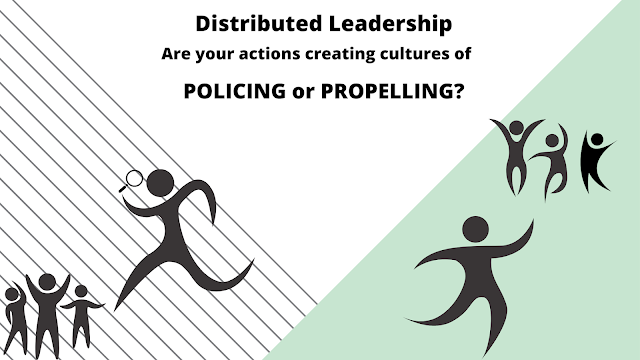
Are you a leader that polices or propels your team?

Image
The idea: As leaders we should be looking to propel our teams members forward much more than we police them. Sometimes, leaders with this intention of 'propelling', send too many messages of 'policing' through the everyday actions they take. Now you might read the title and think this idea is so basic, obviously leaders must propel their teams forward instead of policing them. In my experience, many leaders say this, but they do not always live it. And the culture of an organization is built possibly more on what we do and less on what we claim to do or say. Let’s look at 3 examples of how our actions can send a policing message instead of a propelling one. First, the difference.  ‘Policing’ refers to an old school management style that uses monitoring and maybe some fear to have employees or teams adhere to rules. It is top-down and based on the fundamental belief that your team is not capable/ cannot be trusted to be responsible without supervision.  ‘Propelling’ is u...

Distributed leadership: It's a Dance

Image
The idea: Here are 4 simple analogies to illustrate 'the dance of distributed leadership' or the synergy between learning organizations and its individual team members - Biryani, A River, A Forest and A Band. ‘Learning Organizations’ (coined by Peter Senge) and Distributed Leadership are ideas that have had a strong influence on me as I have learned more about leading schools and building cultures of innovation. Complex organizations like educational institutions are impacted by many moving parts and are set in a fast evolving world. In order for them to thrive, they must be Learning Organizations. Learning Organizations are built on a Shared Vision with a Distributed Leadership structure and strong systems for team learning. You can read more about this powerful idea in Peter Senge’s book ‘The Fifth Discipline’. While I am still deepening my own understanding about Learning Organizations, I will share a few simple analogies that I have used in the past to help my teams underst...

Using data-driven approaches at school? Avoid these mistakes

Image
The idea: Here are 3 common mistakes to avoid when adopting data-driven approaches in your schools: #1 Lacking a clear purpose for collecting data, #2 Failing to tackle data aversion/ fearing mindsets in the community, #3 Drawing conclusions without analyzing the reliability of the data  For any School that wants to be innovative and improve quickly, data-informed approaches/ improvement science approaches should be central to their functioning. Read more about adopting an Improvement Science Approach in schools in this book:  Learning to Improve: How Americas Schools Can Get Better At Getting Better .